

WHITE PAPER | PPG TECH
IT Vendor Headaches in City Government
What 24 Cities Said Behind Closed Doors: Common Challenges, Empowering Solutions
October 23, 2026
Author: Nathalie Rayter
Contributors: Denise Linn Riedl, Claire Brawdy, Damonique Sonnier
Partners for Public Good (PPG) brought 24 city government IT leaders together to talk honestly about their working relationships with existing IT vendors. In this review of the outcomes we’ll discuss the common challenges we uncovered as well as solutions jurisdictions honed in on together.
Too often, a city’s ceiling of IT success is determined by the state of its relationships with its most critical technology vendors. Vendor working relationships and routines impact a city’s data sophistication, business continuity, pace of technological innovation, and their budgets. Time and again, PPG hears about functionality promises made during scoping that fall flat during implementation; product roadmaps that don’t evolve with a city’s needs; and data limitations that prevent essential interoperability and reporting. Even day-to-day customer responsiveness (or lack thereof) can jeopardize trust and operational efficiency.
Jump to: What Vendors Told Us
What We Learned
Seven Actions Cities Can Take to Build Collective Market Power
Key Takeaways
When it comes to scoping and implementations, the wrong people are in the room
Procurement processes weren’t designed for the technology we’re buying
Pilots promise more than they deliver, and it’s not always the vendors’ fault
Feedback loops are broken or nonexistent
The Conversation: Uncensored
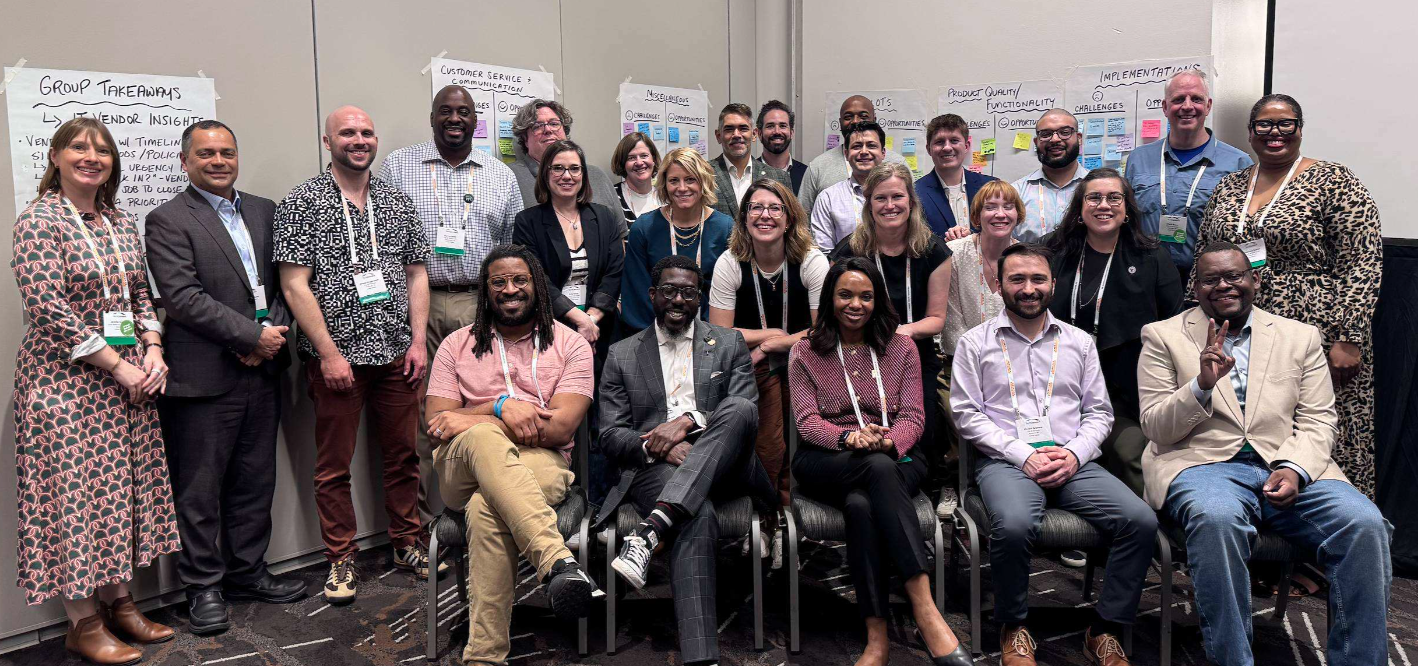
In March 2026, PPG hosted a roundtable at the Smart Cities Connect Conference in Raleigh, N.C., with the goal of giving government technologists a rare opportunity: a vendorless space to build community, swap notes, and talk about their struggles candidly. There were no sponsors, no product logos, and no need to mince words about the SaaS, managed IT service partners, cybersecurity consultants, or new AI-native tools cities interact with constantly.
For the Roundtable, we abided by Chatham House Rules, whereby any quotes and insights from the session will not be attributed to any specific participants. You’ll notice this reflected in the anonymous quotes and aggregated data.
Diverse Cities, Similar Pain Points
The cities and jurisdictions represented spanned a wide range of sizes and contexts, from smaller municipalities of under 100,000 residents navigating resource constraints, to mid-size cities managing complex, multi-department technology portfolios, to some of the largest urban jurisdictions in the country with populations exceeding half a million.
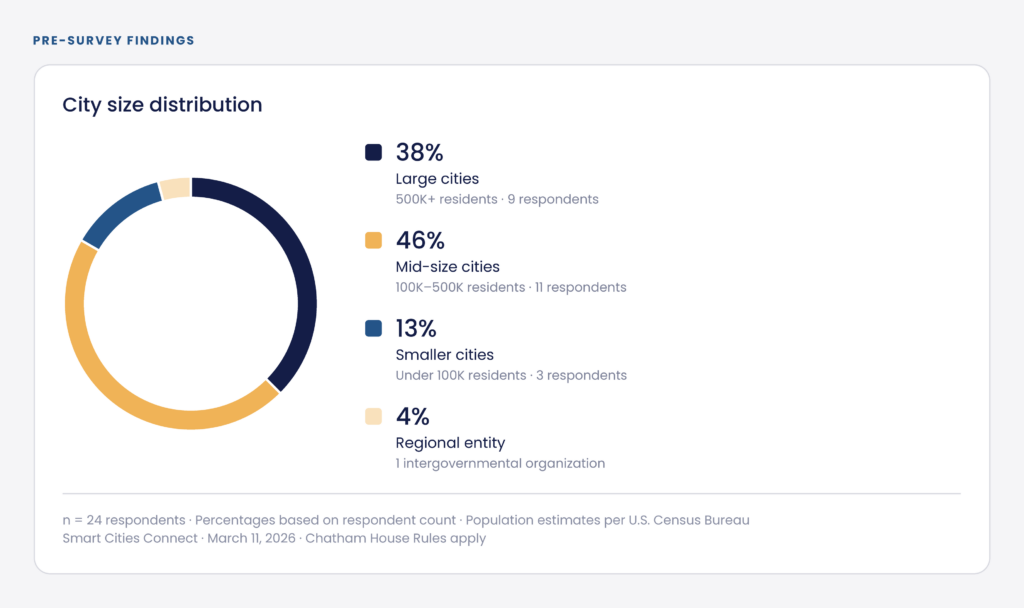
Despite these differences in scale, participants arrived with strikingly consistent concerns. In a pre-event survey, nearly all participants ranked functionality gaps between what vendors promise and what they deliver as their top challenge. Virtually every respondent flagged switching costs, poor customer service, and API and data access barriers as significant pain points.
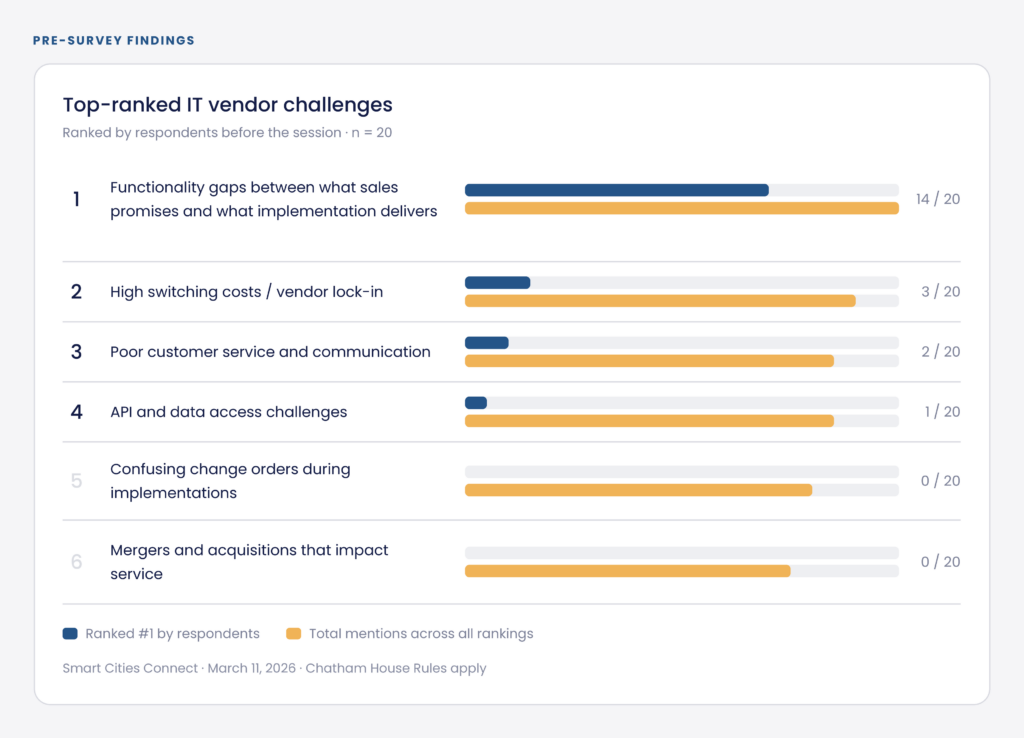
The consensus on these issues across city sizes suggests these are structural features of the government-vendor relationship, not isolated experiences.
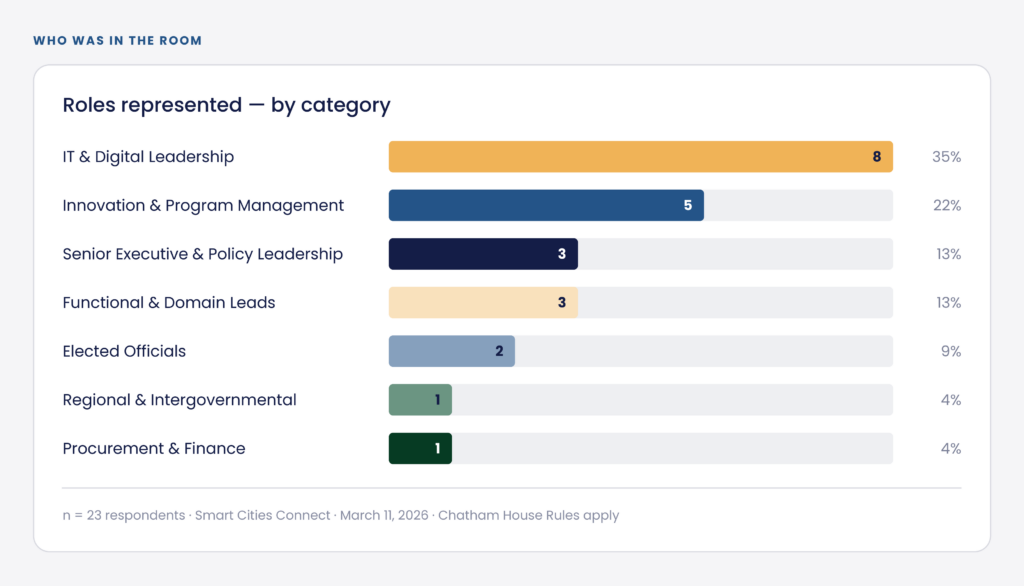
IT and digital leadership made up the largest share of participants, joined by innovation and program managers, senior executives and policy leaders, domain leads, and a few elected officials.
How the Roundtable Worked
The three-hour session was designed as a journey from individual stories to collective patterns and actionable ideas. Five table facilitators (Nathalie Rayter, Damonique Sonnier, Claire Brawdy, and Denise Linn Riedl from PPG, joined by Margaret Mullins from the Vanderbilt Policy Accelerator) guided our city participants through a series of design thinking exercises.
We started with a silent brainstorm, asking participants to write down specific, granular challenges they’d experienced working with IT vendors, for example, “in order to get the responsiveness we needed, we had to pay a third party to manage our code enforcement system tickets.” In reality, the brainstorm was far from silent: Our participants had a lot to share!
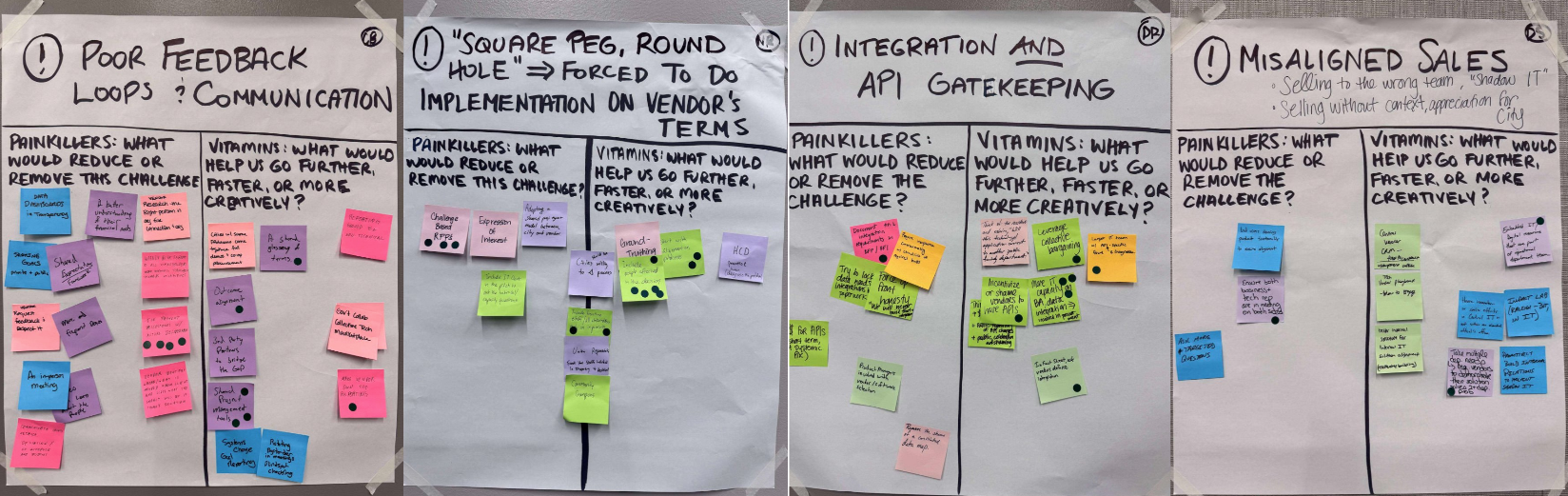
Participants organized their 88 (!) challenge sticky notes by category on big T-charts around the room: Implementations, Pilots, Customer Service and Communication, API and Data Access, Product Quality and Functionality, and Miscellaneous. Then we asked the same question in the other direction: What has actually worked? Participants placed their solutions on the same charts, this time on the positive side, and voted with three sticky dots each on which challenges resonated most. We closed by asking groups to brainstorm solutions, both “painkillers” to reduce immediate friction and “vitamins to build longer-term capacity.
What Vendors Told Us
Earlier in 2026, PPG Tech conducted a listening tour of 14 tech vendors who sell to state and local governments, and we heard a lot about the same dynamics from the other side of the table. During the Roundtable, we shared the vendor perspectives we heard in our research and asked participants to respond.
Sharing these quotes with city leaders generated real reactions: a mix of recognition, frustration, and, in some cases, genuine empathy.
What struck us most was the overlap in the pains both parties felt: Vendors also want earlier engagement, feedback, and greater government capacity to scope, implement, and truly product-manage with them. Both sides are operating within structural conditions that make building good relationships challenging.
What We Learned: Seven Themes
Across more than 80 brainstormed challenges and over 30 documented wins, seven themes emerged. They all pointed to structural features of the government-vendor relationship that show up regardless of city size, region, or technical maturity.
1. Vendors don’t always account for your city governance and collaborative structure
They will sell technology across departments, sometimes creating procurement, IT, and budgeting chaos.
One of the most consistent frustrations surfaced at the roundtable was the experience of IT staff being brought in to implement a technology solution they had no role in selecting. The top-voted challenge of the entire session, “IT comes in after department is sold on specific software, expected to implement,” captured this dynamic precisely.
>What cities tried: Some cities created a single front door for technology vendors. They had active forms or emails meant to catch initial interest and give visibility to all departments. Other cities contemplated coordinated “demo days,” that brought multiple departments together for common challenges or enterprise needs.
Other cities leveraged market intelligence and research request tools, which are also the first signal that a department is on a technology procurement journey. IT, procurement, and other teams can engage early as a partner instead of as a last-minute advisor or surprised approver.
Of course, nothing replaces better, proactive relationships across departments. Knowing teams’ goals for the year and regular meetings result in earlier coordination.
2. What sales promises, implementation inherits
Technical staff (on both the vendor and city side) get shut out of sales and scoping rooms that would benefit from their presence.
Cities are often unable to speak with a vendor’s technical team until after contract award, meaning the people who understand what implementation actually requires are excluded from the conversations where expectations are set.
Both cities and vendors inherit the consequences: change orders, extended timelines, and in some cases, contract terminations. Others described functionality that proved unavailable or prohibitively expensive during implementation, not because it was misrepresented, but because demos are typically built to show a product’s potential rather than the full scope of work required to get there.
Challenge: “We can’t talk to the tech team until after the contract is awarded.”
What cities tried: The most clear and simple solution was to habitually include relevant city IT staff in sales and scoping calls to catch these issues early. This is easier said than done, however. Participants noted that these same staff are constantly fixing broken integrations, troubleshooting across enterprise software, and putting out other IT fires. CIOs need to carve out time for these teams to play a more strategic role in procurement.
Before signing any documents, cities can ask for a feasibility review on scope and functionality assumptions from a member of the vendor’s implementation team.
Cities shared the common pitfalls that lead to misalignment for everyone to watch:
- assumptions about division of labor in implementation scoping
- assumptions about hours/effort dedicated to data migration
- whether integrations exist or are merely in a product roadmap
- pushing back on what is “customized” or truly “configurable” in a system for easier maintenance on the city side
3. Traditional procurement creates misalignment before work even begins
The structural conditions of public procurement (like quiet periods that limit pre-award communication, overemphasis on requirements, and scopes written before problem definition) create misalignment before work even begins. Cities described implementations extending far beyond projected timelines and change orders arising not from scope creep but from the inherent difficulty of specifying complex technical work before it begins.
Challenge: “We got a change order because the vendor scoped poorly. They tried to have us absolve their mistake.”
What cities tried: Participants discussed more innovative approaches like challenge-based procurements, agile procurement methods, and modular procurements. As one participant put it: “When the city could clearly state the problem and process, we got better results [from the tech].”
Resources from PPG to address these challenges can be found on the Procurement Excellence Network (PEN) Resource Page.
4. Great IT project management in cities is too rare
Without this capacity, cities implement projects on the vendors’ terms, not their own.
Across cities, staff capacity to truly project manage implementation and pilots and, overall, manage vendor work was cited as low. These personnel monitor implementation closely, pull in champions/experts, escalate issues, keep stakeholders accountable and informed, and manage expectations during technological change on both sides.
Even when vendors supply project managers, they can be loyal to the companies and not the cities and do not always lead project timelines or share information in the way that is most helpful for the city.
Challenge: “Onboarding took too long—we procured the tech product almost two years ago, and it’s still not fully implemented.”
What cities tried: Formalized project charters, Change Control Boards, and milestone-linked payment structures all created shared accountability structures that helped both sides navigate uncertainty more effectively.
5. Pilots are under-resourced, under-prepared, and over-promised
In theory, pilot programs offer a lower-stakes opportunity for cities to evaluate new solutions before they commit to full implementation. In practice, pilots frequently fall short, not because the concept is flawed, but because the conditions needed to make pilots work are rarely in place.
Cities often lack the data readiness, dedicated staffing and time, and success metrics needed to generate a meaningful signal from a pilot. Vendors, meanwhile, position pilots as lightweight engagements when the investment required to make them genuinely evaluative is considerably higher. Challenge: “We sold an AI pilot without an initial assessment of data readiness. The pilot is useless and leadership is unhappy.”
What cities tried: Cities achieved more readiness and success with pilots when leadership, from the start, managed pilot expectations internally (for instance, emphasis that the goal was learning and that the pilot itself was an investment) and formalized KPIs to track ahead of the technology turning on.
6. After go-live, capacity gaps for product management have quantifiable consequences
Government IT teams are frequently asked to manage complex, high-stakes vendor relationships without the staffing, technical expertise, or bandwidth that those relationships require.
This is not a reflection of individual capability; rather, it is a resource and prioritization gap that has accumulated over time, as complexity has outpaced investment in the teams needed to manage it.
Vendors, once a contract is signed, have fewer immediate incentives to seek out feedback. Procurement processes that emphasize formal deliverables over ongoing dialogue leave little room for iterative course-correction. Cities get surprised by product changes or updates and they can’t shape partners’ roadmaps and future functionality if they don’t have the capacity to stay in the conversation.
Challenge: “We had to hire a third party to manage Accela customer service costing extra money to get bare minimum.”
What cities tried: Cities that have invested in dedicated roles like product managers, embedded IT liaisons, or integration specialists reported better outcomes. One example: “The business relationship manager (BRM) acting as IT liaison for other departments.”
7. Data and API access is a persistent, costly barrier
Cities increasingly depend on the ability to move data between systems, build integrations across platforms, and maintain ownership of the information their operations generate. Proprietary architectures, limited API availability, and data access structures that treat interoperability as an add-on rather than a baseline create real operational constraints for cities. They also incur real costs, both financial and technical.
Roundtable participants described being unable to extract usable data from systems they were paying for, encountering poorly documented data structures and additional charges for API access, increasingly considered a basic expectation of modern software.
Challenge: “Vendors charge extra for API/data access.”
What cities tried: To gain more control over their data, participants identified opportunities in proactive contract language, internal standards, noting that “internal standards allow for faster API connection partnerships.”
Seven Actions Cities Can Take to Build Collective Market Power
The solutions surfaced at the Roundtable pointed to key actions cities can take. Some involve big investments in talent, staffing, and new ways of working. Other ideas require lower effort.
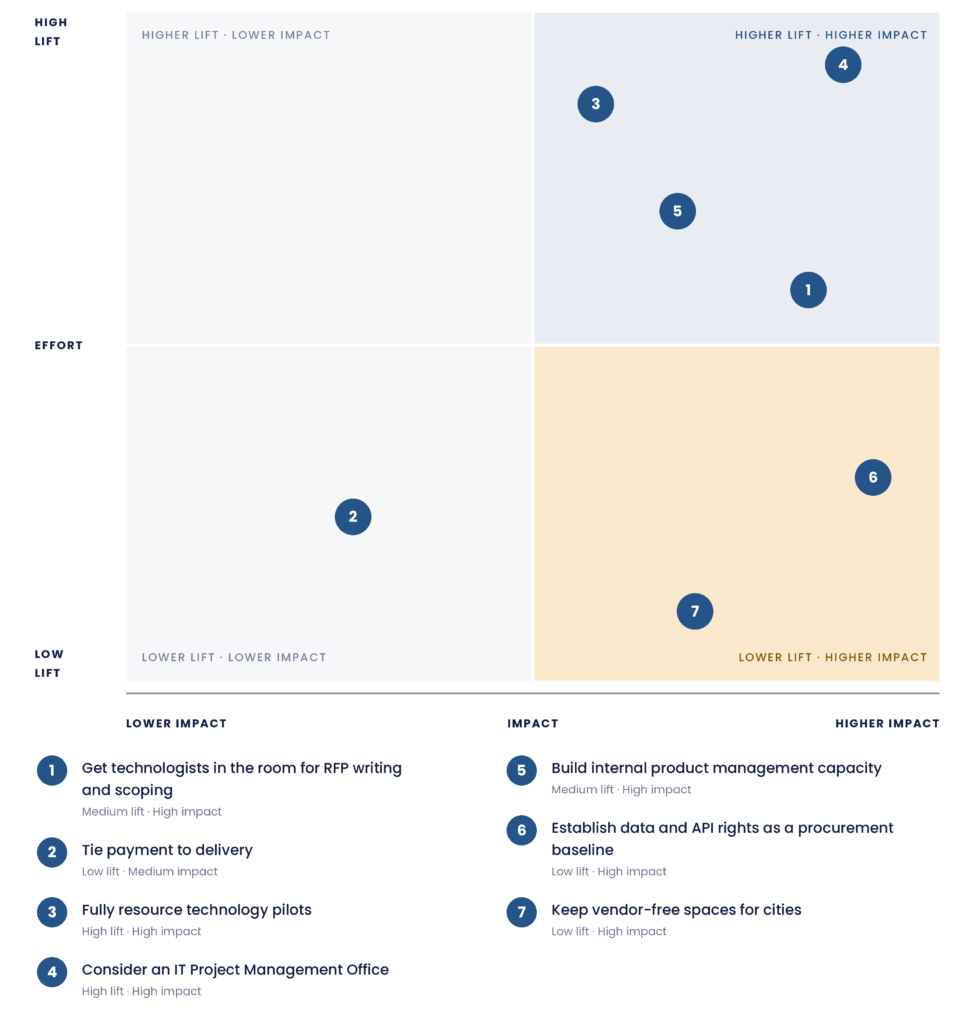
- Get technologists in the room for RFP writing and scoping. Vendors, too. Ground-truthing (bringing frontline staff, end users, AI experts, and IT implementers into solicitation writing, vendor evaluation, and selection) was seen as one of the most direct ways to close the gap between what gets purchased and what actually works. Challenge-based RFPs, which define outcomes rather than prescribing solutions, received strong support as a structural complement to this approach. Medium Lift, High Impact
- Tie payment to delivery. Participants saw tying payment milestones to actual deliverables (instead of calendar dates) as one of the most actionable near-term changes available to cities. This would create shared accountability without requiring procurement reform. Cities noted the risk of work done faster, not better, and recommended the field continue to share what works for performance-based contracting in the IT context. Low Lift/Medium Impact
- Staff and manage pilots as real, not side, projects to set them up for success. Cities saw the need to staff pilots properly and put time into readiness and true evaluation. High Lift, High Impact
- Know the cost of not having a dedicated Project Management Officer (PMO) for IT, and make the case for one. A vendor-based project manager is not incentivized to save their government customer’s implementation. Project management capacity internal to government (or another third party more loyal to the city than the product) is an essential ingredient to implementations that are successful and agile as necessary. High Lift, High Impact
- Build the internal capacity to manage products after go-live and maintain communication channels with tech partners. Participants consistently pointed to the need for dedicated staff capacity to manage tech contracts as a prerequisite for healthier vendor dynamics. Expanding product management capacity doesn’t have to entail net new positions. Playing “offense, not defense” on vendor relationship management, product management could be as simple as new quarterly call routines and/or a more sophisticated internal issue tracking and escalation routine. Medium Lift, High Impact
- Make data and API rights the baseline in tech procurement. Participants called for contract language that protects data access and requires open APIs as a standard expectation, not a negotiated add-on. Creation of a public vendor transparency scorecard, rating vendors on interoperability and data portability, could introduce reputational incentives for better behavior across the market. Low Lift, High Impact
- Lastly, all cities agreed: We need more vendor-free spaces for cities to discuss procurement, delivery, and product partnership headaches. Sharing information not only eased burdens and built community; it generated ideas that point to a future with collective market power where cities incentivize the behavior they want from their partners. Low Lift, High Impact
Where We Go From Here
The themes surfaced at this roundtable aren’t new to anyone who works in government technology. What is striking is how consistent they are across city sizes, regions, and organizational structures. This consistency points to the structural nature of the problems and the need for shared tools, shared intelligence, and shared standards that make it easier to act on what practitioners already know.
That is the technology work PPG is focused on. We see this report as the beginning of an ongoing conversation, and we welcome more cities, jurisdictions, and vendors into it.
Partners for Public Good is a nonprofit that helps state and local governments harness core operational functions—procurement, staffing, IT, and budget—to drive public impact. PPG ‘s technology experts support digital transformation, capacity building, AI piloting, and product innovation for back-office government teams. All session insights in this report are included under Chatham House Rules.