

Better Infrastructure Outcomes Are Within Reach. Procurement Is the Key.
It’s never been more important to get infrastructure right in the United States. Much of America’s infrastructure is aging and approaching or exceeding its intended lifespan, with systems like roads, bridges, and water networks often decades old and in need of major rehabilitation.
While federal and state governments have deployed historic levels of funding in recent years across a wide range of infrastructure-related sectors, including transportation, water, and energy, challenges remain. Construction costs have risen sharply, outpacing inflation and international benchmarks; research shows that comparable projects can cost multiple times more here in the U.S. than abroad.
The stakes are high, and so is the potential. Every $1 in public infrastructure investment is estimated to generate $1.50 in economic activity. Local communities desperately need modern, reliable infrastructure, but funding alone is not enough.
How agencies structure the buying process can meaningfully impact whether these investments fully deliver, ensuring projects come in on budget, on time, and with lasting value for residents.
The Missing Lever: Procurement
Despite bipartisan support for infrastructure investment, projects are too often delivering less value than expected as funding moves to implementation. Compounding these cost pressures, the market for public construction is becoming less competitive; fewer bidders are participating in public projects, driven by industry consolidation, capacity constraints, and increasingly complex procurement processes.
The opportunity here is significant. Policies and practices that shape procurement design and market structure, such as the level of competition, play a central role in determining project costs and outcomes. Infrastructure costs are not driven by materials or labor alone; project delivery methods and procurement choices shape efficiency, price, and results. What’s needed is not just more funding or new mandates, but better processes that improve delivery and create value by increasing competition.
This is at the heart of Partners for Public Good’s work. Through Infrastructure for Public Good, Partners for Public Good helps state and local governments plan and deliver infrastructure projects that improve daily life, from safe streets to clean water, effectively and efficiently for residents.
A Playbook for Smarter Procurement
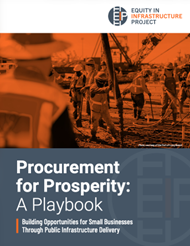 As part of this work, Partners for Public Good designed Procurement for Prosperity: A Playbook for the Equity in Infrastructure Project (EIP), which offers a set of actionable tools for agencies to expand access, strengthen competition, and ultimately deliver better infrastructure outcomes for residents.
The playbook demonstrates that infrastructure outcomes are shaped by more than just funding levels, including how government agencies structure and run procurements. When agencies lower barriers to entry, improve transparency, and engage their markets early, they expand the pool of capable bidders, strengthen competition, and see better results.
What This Looks Like in Practice
The fixes outlined in the playbook are not theoretical. They are operational strategies already being deployed by forward-thinking agencies facing rising costs and tightening fiscal pressure. Leading agencies are finding success through practical procurement reforms:
- Early and transparent forecasting so firms can prepare
- Proactive outreach and engagement to expand the pool of bidders
- Clear entry points and simplified processes to reduce administrative burden
- Metrics and data systems to track participation and outcomes over time
Building Markets: the MWD Story
Some public agencies are already shifting in this direction by treating procurement as a tool to build markets, and the results speak for themselves.
The Metropolitan Water District of Southern California (MWD)’s small business program, established by its Board of Directors in 2001, builds contractor opportunities through a 25% small, regional, and disabled veteran-owned business contracting goal and strong sub-contractor utilization requirements. Since the program’s inception, MWD has reinvested more than $2B into the Southern California small business economy.
From Zero Bids to Four: The Village of Peck
With the right outreach, market insight, and procurement design, even small or remote communities can expand bidder pools and improve outcomes
The Environmental Protection Agency (EPA) provided a $762,000 grant to the small village of Peck, Michigan to repair and extend critical water and sewer infrastructure. However, recent solicitations yielded one or no bids, in part due to the Village’s small size and rural, remote geography.
PPG helped build a vendor database of firms that had bid on similar projects and designed a vendor survey to better understand vendors’ barriers and motivations. The village ultimately received four bids with a low bid of approximately $460,000, including three bids from contractors who had never bid locally before.
Make Procurement Work for Your Community
Getting procurement right is one of the most immediate and actionable ways governments can improve infrastructure outcomes. The opportunity is not just to spend more, but to spend better by structuring procurements that attract more bidders, strengthen markets, and deliver greater value for communities.
For government practitioners and leaders interested in learning more, the Procurement for Prosperity Playbook is a practical place to start, and one worth sharing with colleagues. For those preparing upcoming infrastructure projects, Partners for Public Good offers hands-on support to help structure procurements, engage vendors, and drive more competitive, higher-value outcomes.
Explore our offerings and reach out to schedule a conversation.