

LAX is Delivering Through Innovative Project Design
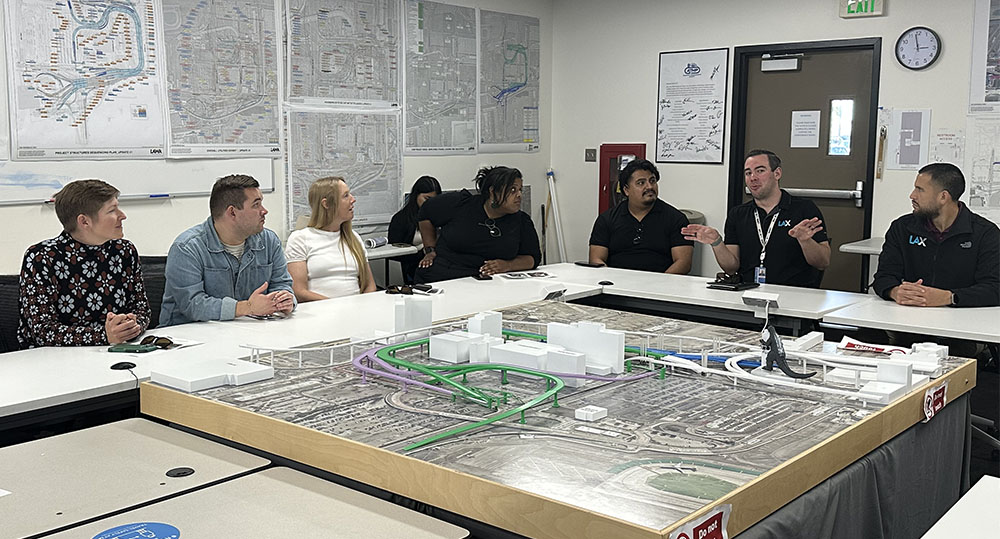
Public infrastructure projects are often seen as slow, disruptive, and hard to deliver on time and on budget. And for Los Angeles World Airports (LAWA), the City of Los Angeles department that owns and operates LAX and Van Nuys Airport, the stakes are high. LAX—one of the world’s busiest airports, with 73.7 million passengers in 2025—has long sought ways to improve ground traffic and passenger experience within a relatively limited footprint.
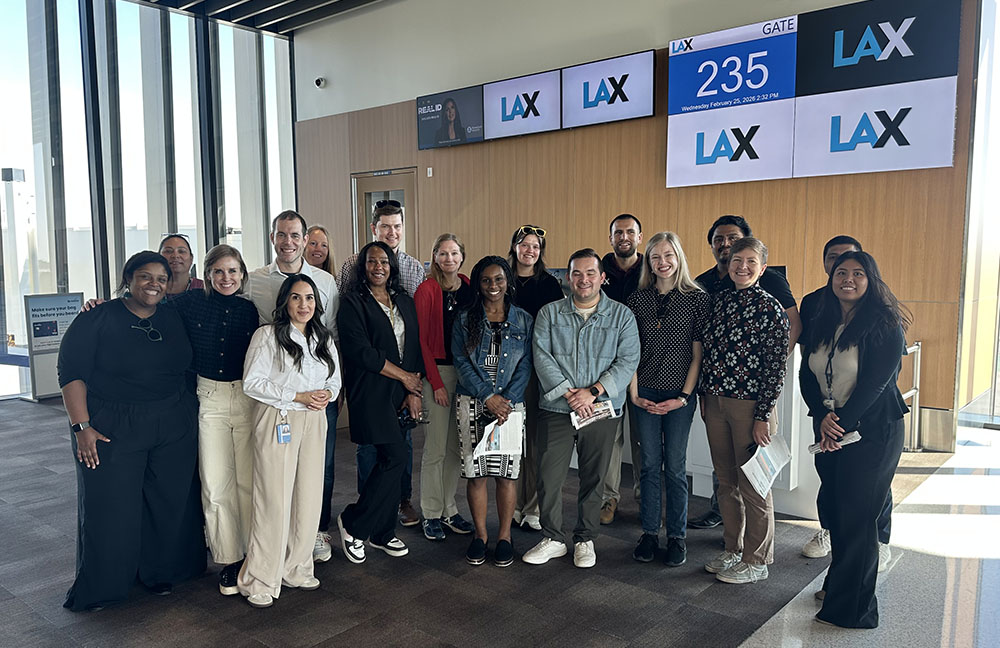
As part of LAX’s community outreach efforts, Amber Meshack (Director of Business, Jobs, & Social Responsibility) hosted the Partners for Public Good team for a site visit of two major infrastructure projects: the new passenger gates at Midfield Satellite Concourse (MSC) South and the Airfield and Terminal Modernization Project (ATMP) Roadway Improvements Project. Here are a few of the innovations and lessons for other governments that stood out:
1. Your project’s delivery method should be as dynamic as your project
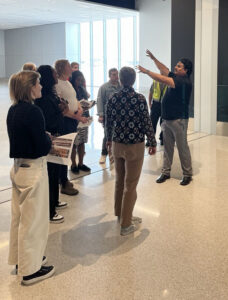
The projects in LAWA’s multi-billion-dollar capital improvement program were chosen to achieve different goals, and choosing the right project delivery method for each was important. For MSC South, LAWA chose the Construction Manager at Risk (CMAR) method to prioritize a guaranteed maximum price and appropriate allocation of risk. Officials adopted a progressive design-build approach for ATMP Roadway Improvements allowing for project iteration and collaboration.
Each approach optimizes for different ways to manage resources while preserving flexibility and sustaining owner-contractor engagement on high-complexity projects. In addition to innovating in project delivery, LAWA fosters collaboration through co-locating airport project management staff with project consultants — allowing for stronger communication. This is not only between the owner and client, but also between LAWA and staff from other City of Los Angeles departments.
What this means for government leaders: Let core project needs inform the right project delivery method and remain open to innovative approaches.
For more guidance on project delivery methods, see Partners for Public Good’s Project Delivery Method Guide.
2. Make innovative use of the resources you have
LAX houses airport operations within a remarkably small footprint relative to other airports. Maintaining operations while building new facilities is difficult because of the security requirements of an active airfield and the high volume of passenger traffic. That desire to reduce the frictions of on-site construction activity is what drove LAWA to look for innovative solutions to build the MSC South project. It found the solution in its own backyard.
LAWA and its contractors built MSC South using a method called “Offsite Construction and Relocation (OCR),” where the facilities segments were built in an area located off the airfield but still on LAWA property and later transported overnight to the final site for assembly. The benefits were many —including minimized construction disruption to an active airfield and a reduced timeline and costs.
Additionally, LAWA’s choice of OCR decreased barriers to participation for local workforce and small contractors who might otherwise not have received clearances to work on the airfield, which requires thorough background checks and other reviews. Because the offsite construction area was outside of the airfield, workers from a greater proportion of the population faced fewer barriers to apply to work on the project.
What this means for government leaders: Get creative with available resources to improve risk, costs, and timelines, especially in high-security or constrained physical environments.
3. Inclusion can be a core strategy
LAWA runs extensive workforce development programs, including targeted recruitment campaigns, apprenticeship preparation programs such as HireLAX, and a Project Labor Agreement to increase opportunities for local communities. Together with other relevant City of Los Angeles departments, LAWA promotes business inclusion through certification programs, incorporating inclusivity criteria in evaluations, extensive outreach to the community, and most recently, a series of Multi-Award Task Orders (MATOCs) that make inclusivity a requirement, not a goal.
This is what intentional design for inclusion looks like in practice: not a separate program bolted on after the fact, but a project decision that opened doors for workers who would otherwise have been locked out.
What this means for government leaders: Find ways to reduce barriers to contractors and workers within each project, not just in larger programs.
4. Sustained community engagement is critical to project success
The ATMP Roadway Improvements Project will reconfigure and rebuild more than four miles of roads going into and out of LAX. With a project scope that includes ongoing activity so close to airport-area stakeholders and communities, LAWA began—and has continued—extensive community engagement across the project’s design and delivery.
LAWA continues to inform neighborhoods and businesses in the immediate project area of upcoming work, with information provided before construction activity begins, and any additional and relevant updates. The project team also made efforts to incorporate community-submitted design ideas for consideration into the final project design.
This process was preceded by extensive engagement between LAWA and its contractors, starting with the RFI process and solicitation development, which was followed by pre-proposal conferences on site.
What this means for government leaders: Community engagement doesn’t end at the design stage; incorporate ongoing, consistent, and adaptive outreach throughout the lifecycle of a project.
Takeaways for Infrastructure Delivery
Whether a project is a multi-billion dollar roadway or a single water main in a rural community, intentional choices about procurement, inclusion, and community engagement are critical to effectively building public infrastructure that serves the people around it. Partners for Public Good works with governments at every scale to apply these principles, helping leaders make smarter procurement decisions, design for inclusion from the start, and deliver infrastructure their communities can be proud of.
Working on a challenging infrastructure project? Partners for Public Good offers support to help government leaders at every level plan, procure, and deliver more effectively. Reach out to start the conversation.