

Connecting Governments Globally to Improve Procurement Locally
State and local governments are entering a period of major disruption in how they buy goods and services. Technological change is spurring a rethinking of long-established procurement processes; budgets are tightening; and government staff are facing growing demands and pressures.
But as the field of public procurement evolves, it’s more critical than ever that state and local governments meet the mandate of translating public commitments and dollars into visible resident outcomes.
Partners for Public Good has long invested in scaling innovative methods of procurement to state and local governments nationwide. Our theory of change is grounded in:
- Helping procurement teams focus on results and best value, not simply compliance or risk avoidance
- Building the leadership support, political will, and authorizing environment to support 21st-century procurement
- Driving innovation that solves core challenges, not just incremental improvements
To do this, we need to look beyond our borders for inspiration. There is a real opportunity for Partners for Public Good and for U.S. procurement practitioners and thought leaders to benefit from more exposure to international best practices, particularly across Europe and the United Kingdom.
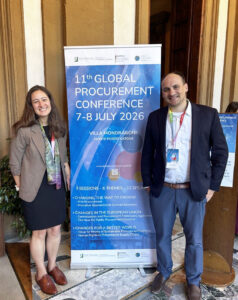
The 11th Global Procurement Conference in Italy this July was a welcome opportunity for my colleague Elena Hoffnagle and me to absorb knowledge of innovative procurement models. We also had the opportunity to present about novel approaches to contract execution from across the U.S.: how local governments can recenter on the importance of managing contracts toward results using data to diagnose and monitor vendor performance challenges.
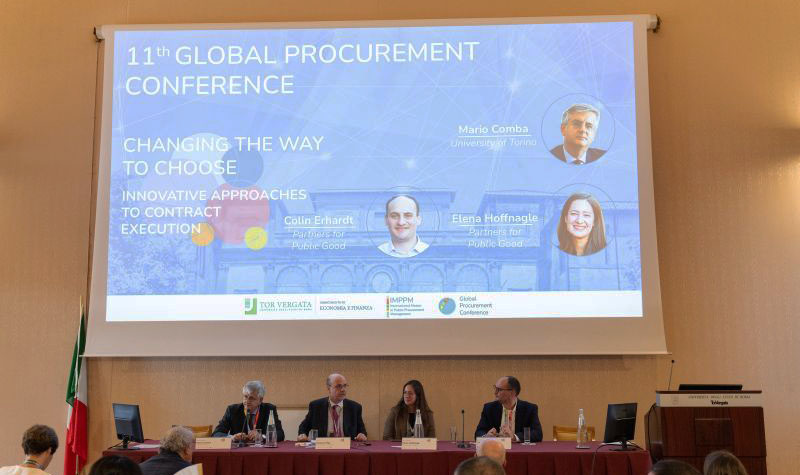
In a room full of procurement practitioners, researchers, academics, and thought leaders from across the globe, there was a shared sense of the critical inflection point public procurement is at right now.
While major strides have been made in moving the function from transactional to strategic, there are looming challenges and pressures ahead for all public entities. Government leaders must harness AI while carefully governing its use in procurement operations. Market consolidation across industries is reducing vendor competition. And procurement teams are being asked to do more with less. But, despite the hurdles that governments are universally experiencing, there was an energy of optimism in the room, and throughout the conference.
Public Procurement Challenges Are Global
Many micro level problems are universal and have been around for decades—from the need to balance efficiency with fairness and competition to reducing a reliance on sole source contracts. On the macro level, as policy reforms launch internationally, new questions emerge.
Take for example that innovation procurement methods (e.g., public procurement of innovative solutions or solution-design and prototyping) have been promoted across the E.U. and even authorized in updated rules and regulations. Yet, procurement teams aren’t embracing these methods, possibly due to risk aversion and lack of experience.
During our trip to Italy, one story stands out from meeting with a practitioner from the City of Rome. Like many U.S. cities, Rome was excited to pilot and experiment with new ways to use procurement to engage and hire new vendors. They aimed to better deliver for the city and to advance economic development efforts in the region. We’ve seen similar efforts in many of our projects, including in Long Beach, Calif., Kitchener, Canada, and New York City.
Rome has visionary practitioners motivated to experiment with new methods that leverage procurement for community development progress and to solve real, visible problems (such as improving river water quality). But they face similar challenges to U.S. cities, with siloed efforts between departments and teams with different missions and priorities, and risk aversion from staff who are happy to try out a short-term startup vendor, but less ready to sign a longer, formal contract.
Our Untapped Resource: Each Other
The work that’s already being done across Europe at the national and sub-national level offers myriad lessons and opportunities to implement what’s already working: from procuring innovative solutions to incorporating lifecycle costing into evaluation criteria, advancing environmentally sustainable procurement, digitizing procurement information to enable more strategic procurement planning, and professionalizing the procurement function.
For many of these topics, U.S. local governments can benefit from understanding what’s been tried internationally, and what may be applicable to a U.S. context.
A More Collaborative Tomorrow
The collaboration has already begun. We’re bringing back initial learnings from our peers abroad and incorporating them into our planning for future projects at Partners for Public Good. For example, our own conference presentation on innovative contract management generated ideas for future collaborative discussion, particularly around how European governments are navigating the tension between stronger vendor relationships and preserving fair competition in future procurements.
These conversations reinforced the tremendous opportunity we see for U.S. and European local government procurement teams to learn from one another. We’re excited to help create more opportunities for that exchange. In the months ahead, we’ll be sharing examples of E.U. and U.K. public procurement best practices most relevant for U.S. local governments and will announce new spaces to jumpstart discussion on shared challenges.
If you’re interested in getting more involved in these conversations and collaborating with Partners for Public Good and other local governments, join our Procurement Excellence Network (PEN). Learn more here.